
Vienna
Part Two: Culture, more Culture and the Rocky Horror Picture Show

Vienna has a long history as a leading cultural centre in Europe, particularly after it became the capital of the Austro-Hungarian empire (more about Vienna’s history in a future blog). It’s particularly well known for its patronage of music.
Besides the State Opera Hall, Vienna has six other concert halls, over 100 live theatres, a theatre museum and over 100 night clubs.
The concert halls are an indication of the rich musical history of the city. Wolfgang Amadeus Mozart (there are two Wolfgang Mozarts, who knew?), Schubert, Liszt, Mahler, 4 Strauss’ (Eduard, Johan I, Johan II, and Josef, but not Richard who was German), and Hayden are among the best known Austrian composers who lived or were born in the city.
The State Opera Hall was built in 1861, the successor to the Vienna Court Opera which was originally built in 1636, and is the oldest and longest running opera house in the German speaking world. It has a 2500 pipe organ and amazing acoustics. Or so I’m told, having never been able to get tickets to see anything there. Not that I didn’t half heartedly try. I’m not really an opera fan but felt I was duty bound to at least see one concert there. This was in the days before the internet, so buying tickets required either going to the box office or writing to request tickets. Invariably, I would be too late (oh, that’s too bad, I can’t attend the opera, I’ll probably just read a book instead), but the opera house has a tradition of selling cheap standing room only tickets 80 minutes before the concert. This standing room only crowd is known for its boisterousness in expressing their displeasure if they don’t like the program and its enthusiasm if they do like it.
(If you don’t want to go to the State Opera you can also go to the Volksoper, or people’s opera. If you go to the Volksoper you don’t have to dress to the 9s, only the 8.5s)
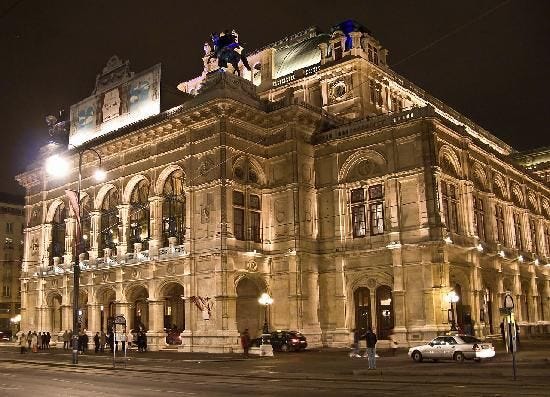
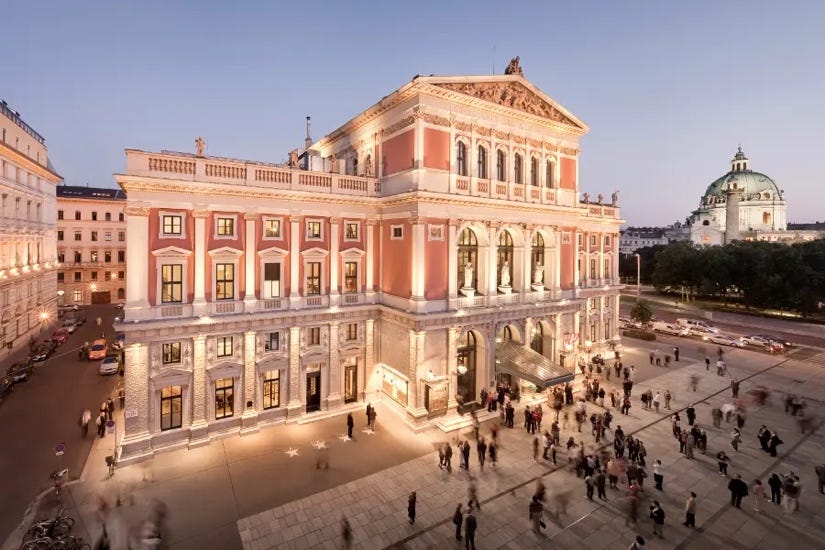
Despite its great acoustics, the State Opera Hall does not have the best acoustics. That title belongs to the Vienna Musikverein, where the philharmonic plays. I have been there. Well, outside anyway, listening at the door on a portable radio.
Every New Years Eve and day, the Philharmonic plays a series of three concerts, with the last one broadcast on radio and TV. The concert consists of a variety of pieces and always includes something from the Strauss family and other Austrian composers, although non-Austrians are included on special occasions (like Beethoven, celebrating his 250th birthday). It also consists of three encores, the second being “Blue Danube” and the third being Johan Strauss I’s Radetzky March, in which the audience is encouraged to clap along (or as John Lennon once said during a Royal concert in the Albert Hall, “rattle your jewellery”).
The Vienna Boys’ Choir was started in 1498 and has been in operation almost continuously, except for a break between 1920 – 1924, and consists of about 100 boys between the ages of nine and fourteen. Although they performed every Sunday plus weekday concerts and touring groups while I was in Vienna, I never saw them. Tickets were really hard to come by. Really.
Another popular and well known Viennese attraction is the Spanish Riding School. I have been there! But, not when the horses were giving a performance. Again, buying tickets in the 1980s was not easy. The Spanish Riding School is known for its classical dressage and its use of Lipizzaner horses. It’s the oldest dressage school in the world (1572) and while women were never officially banned, it wasn’t until 2008 that two women were accepted to train, only 436 years after the school opened. So, ya’ know, good on them for being so progressive, eh?
Vienna also has a tremendous amount of museums and artists. With over 100 museums and galleries, it has long been a gathering ground for painters in particular. One of the best know is Gustav Klimt.
One of Klimt’s most famous paintings was Portrait of Adele Bloch-Bauer I, painted between 1903-1907. It was painted during a period where Klimt was experimenting with using gold leaf and the painting became better known as “The Woman in Gold”. When I was there, I viewed it a couple of times where it was hanging in the Galerie Belvedere in Vienna. But that was to change.
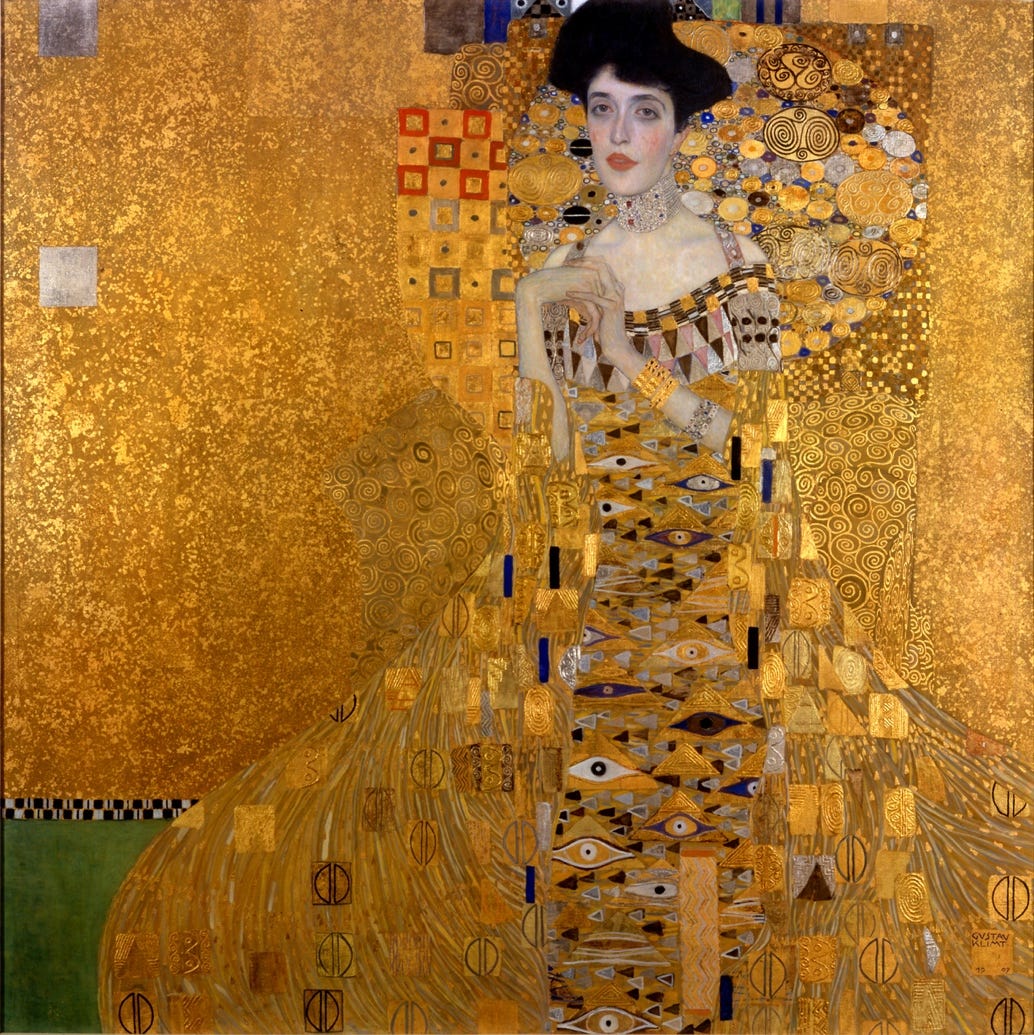
The painting was owned by a prominent Jewish family, who also owned five other Klimts. The legal owner of the paintings was Ferdinand Bloch-Bauer and the woman in gold was his wife. When she passed in 1925, she asked that her husband honour her wishes and donate the paintings to the Austrian State Gallery. He agreed, but in 1945, in his final will he made no mention of the paintings going to the Gallery, instead leaving his entire estate to his nieces and nephew.
By this time, Ferdinand was living in Switzerland having escaped from the Nazis in 1938. The Nazis accused Ferdinand of tax evasion (I guess because he evaded the work camps and death camps, they wanted to get him on something) and all his property was seized by the German Reich. Hitler and Herman Goering took some of the art work but The Woman in Gold and several other Klimts ended up at the Galerie Belvedere.
Rabbit Hole
Ferdinand had a castle (yes he was that rich) in Czechoslovakia that was taken as the personal residence of Reinhard Heydrich, the number two man in the SS. He headed the Gestapo, as well as being one of the principal “architects” of the holocaust. Heydrich was evil incarnate. He was gunned down in Prague in 1942, dying of his wounds a few days later. In retaliation the Germans razed the villages of Lidice and Ležáky, killing all the males 14 and above and sending all the woman and children to concentration camps.
End Rabbit Hole
So, in 1941, the Woman in Gold was in the Galerie Belvedere. By 1998 it was still in the Belevedere, well loved by Austrians and tourists who came to see it, when an Austrian journalist published a series of stories on art stolen by the Germans that the Austrian government refused to return or even acknowledge had been stolen. Ferdinand’s niece, who was living in the US at the time sued the gallery and the Austrian government in the US court system (it’s a long but really interesting story about why they sued in the US and not Austria. For the condensed story I recommend watching the movie “The Woman in Gold” with Helen Mirren and Blake Lively’s husband Ryan Reynolds). Eventually she won the painting back and sold it to a collector in New York on the condition it remain on public display in his gallery. And that he pay $135 million for it.
The final area of cultural entrainment in Vienna (that I want to write about) is the Prater, a large public amusement park. The 1873 World’s Fair was held there. It has a really large ferris wheel and a really narrow gauge railway. (For more about railway gauges read here and here). It also has roasted chestnuts and popcorn.
Speaking of popcorn. One day I’m wandering around Vienna, doing my best not to appear as a vagrant, when I ran into a co-worker who told me that a bunch of people were going to see the midnight showing of the Rocky Horror Picture show at a movie theatre in town. Except it wasn’t at midnight its was at 8PM. Why he called it the midnight showing is a mystery that will never be solved.
I showed up at the appointed time at the correct theatre and there were about 20 people lined up to see the movie and they were all being searched. Apparently, the theatre had played the movie the night before and the audience had shown up with newspapers, rice, toast, toilet paper, water pistols; all the accoutrements required to participate in the movie while watching it, and the theatre had decided they weren’t having that nonsense happen again. (For those wondering what the big deal is, here’s a link to a webpage on how to watch the movie in a theatre – they call it the Virgin’s Guide to participation. https://www.rockyhorror.com/participation/virgins.php. Among their suggestions – go sober the first time. They also have a prop list with suggestions about what to take with you).
So, we got into the theatre, naked of our toys. I bought popcorn. I couldn’t take the popcorn into the screening room, I had to eat it in the lobby. No food in the screening room, that was a standing rule, not just one instituted for us. I noted they offered coffee and sachertorte, also only to be eaten in the lobby.
One of the things about watching the Rocky Horror in a theatre, is the audience talks back to the screen. Not tonight. Every time someone talked back to the movie, an usher removed them from the screening. By the time the film was over, I was the only one left in the theatre.
But at least it was one cultural event in Vienna that I actually attended.