Treason or Forgery
The interesting case of Hans van Meergeren

I’ve been to Amsterdam twice, once in my early 20’s with a Contiki tour and once in my early 30s on my own; both times I visited the Rijksmuseum.
Rabbit Hole
On my first trip I joined a couple of Australian nurses who were also on the Contiki tour and we walked around the red-light district. Afterwards we bought ice cream and they sat on stools in front of the window of the ice cream shop and proceeded to simulate oral sex on the cones, drawing a large crowd of other tourists and causing introverted me to look desperately for a hole to crawl into.
End Rabbit Hole
The Rijksmuseum is located on Museum Square near the Van Gogh Museum, the Stedelijk Museum and the Concertgebouw concert hall. Lotsa culture in a small area and one can easily spend several days just exploring the various exhibits in the three museums.
I am not an art expert in any way, shape or form having just a superficial knowledge of the great masters and the first time I went I only saw the Rembrandts, Van Goghs, and the Bruegels, but I was also introduced to Vermeer.
I’ve mentioned before that seeing a painting in real life compared to a photo in a book is an entirely different experience. This was especially true for the Vermeers I saw that day. When I returned a few years later I spent most of my time in the museum studying the Vermeers.
Vermeer (1632-1675) was only moderately successful when he was alive and almost ignored for two centuries after his death. It wasn’t until he was rediscovered in the 19th century that started to attain the fame he now has. Vermeer was a slow, meticulous painter and there are only 35 paintings attributed to him. It is thought he produced fewer than 50 in his lifetime, the polar opposite of Van Gogh who created over 2,000 paintings, drawing and sketches. Because of this scarcity and an increase in awareness, Vermeers are expensive and sought after.
Allow me to introduce Hans Van Meegeren.
Van Meergeren was a Dutch painter in the early half of the 20th century. He created paintings, sketches, Christmas cards, and whatever he could to supplement his salary as a teacher and keep his family clothed, fed and housed.
Well known as a portraitist but not well thought of as an artist generally, his paintings were too similar to the great Dutch masters and he was accused of a lack of originality. One critic described him as a technician who “has every virtue except originality.”
Van Meergeren decided to prove his critics wrong by creating paintings that rivaled anything the Dutch masters had created. These pieces of complementary art, in the style of the Dutch masters are also known by another name: Forgeries.
After creating two Vermeer like paintings to perfect his technique, (ironically both are now hanging in the Rijksmuseum) he bought a poorly painted 17th century Dutch painting and used that as his base. Mixing his paints using materials available to Vermeer he created “The Supper at Emmaus”.
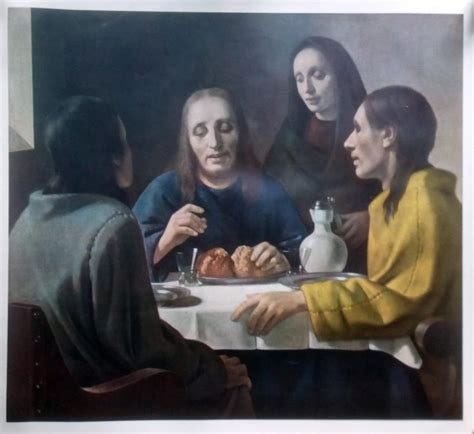
The painting was authenticated and sold for the 2025 equivalent of $5.4 million US dollars and was highlighted in a special exhibition for Queen Wilhelmina’s Jubilee in 1938.
Van Meergeren continued to create forgeries, mostly of Vermeers, well into World War 2, earning about $25 million US along the way. One of his forgeries was “Christ with the Adulteress”.
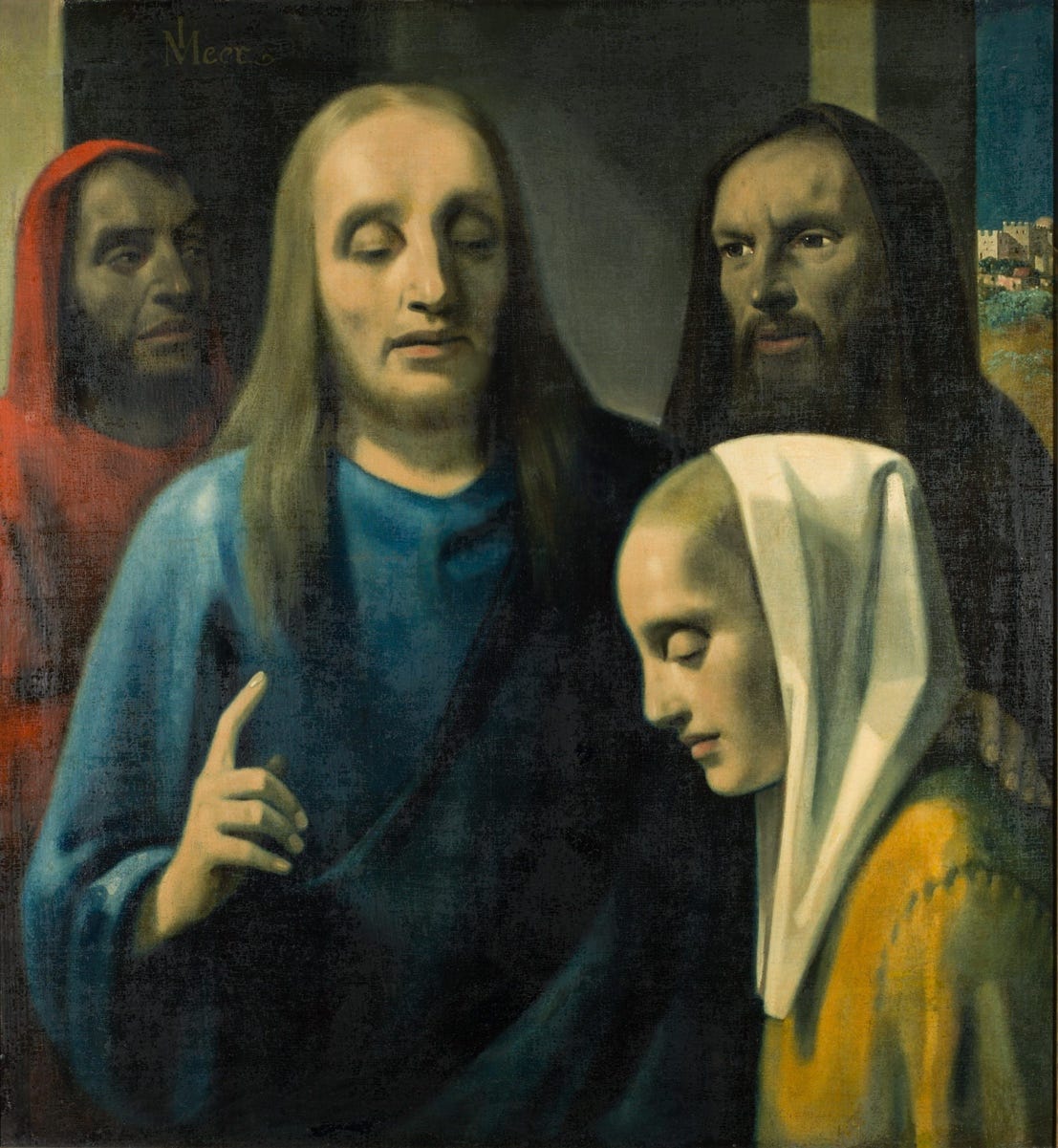
Enter Hermann Göring, Hitler’s heir apparent and self-styled man of the arts. He really wanted a Vermeer but all of them were hidden away to prevent war damage and looting (the French did the same with the artwork from the Louvre). One of the paintings that was available was “Christ with the Adulteress”. In 1943, Göring traded 137 looted paintings for the fake Vermeer, which he then placed for safe keeping, along with 6,750 other looted pieces, in a salt mine Austria.
At the end of the war, Van Meergeren was arrested and accused of collaboration with the enemy and plundering Dutch national treasures to sell to the Germans, and threatened with the death penalty.
Eventually, he admitted to forging “Christ with the Adulteress”, but nobody believed him, convinced that it was an original Vermeer, so for five months, in front of an audience of reporters and court appointed witnesses he painted “Jesus Among the Doctors” in the style of Vermeer.
The court was then convinced that the painting sold to Göring was a forgery and the collaboration charges were dropped, but they then charged Van Meergeren with forgery (I mean they had the courtroom and judge there anyway, might as well use them). He was eventually convicted and sentenced to a year in jail but died before he could serve his term.
He identified eight paintings as forgeries he had created but many experts were skeptical, insisting some must be originals. It wasn’t until 1977 when the newest scientific methods showed materials used in the eight were not available to Vermeer that the debate over the eight paintings was decided.
His estate, including all his paintings, originals and forgeries, furniture and his house were order sold and the proceeds be distributed amongst those who had purchased his forgeries. It came to about $500,000 US. What became of the millions he made?
In December 1943, Van Meergeren divorced his wife, although it was in name only. He then transferred the bulk of his money to her. Authorities were never able to prove she knew the paintings were forgeries so she was allowed to keep the money and lived a luxurious life until her death at age 91 in 1977.
Below is probably Vermeer’s most famous painting, “The Girl with the Pearl Earring”.