
Cheese!

I saw a story a few days ago about Camembert. You may remember from a previous post that Camembert is one of the cheeses that comes from Normandy. Barb and I are planning to visit the town of Camembert and indulge in some cheese when we get to Normandy.
This story appeared in March 2024 but only caught my attention this week. According to scientists the fungus that makes camembert, Penicillium camemberti, has a limited genetic line and difficulty reproducing. It’s possible that at some future date cheeses makers may have to say to Camembert goodbye, rather than good buy. [Editor’s Note: That was a really cheesey homophone]. In the country that invented existentialism, the media have created an existential crisis, at least among some cheese lovers.
“Blue cheeses may be under threat, but the situation is much worse for Camembert, which is already on the verge of extinction,” the French National Center for Scientific Research (CNRS) said in its report about the findings. Elsewhere, another headline warned of a looming “cheese crisis,” adding, “say a prayer for Camembert!”
Fun fact, that assonance “prayer for Camembert” also works in French – “priere pour le camembert”.
Anyhoo, the problem is that industrial manufacturing of cheeses is causing shortages of some fungus or molds as they cannot reproduce fast enough to meet demand.
Patrick Rance, a cheese expert who authored a guide to French cheeses, wrote about this in his 400 page opus “The French Cheese Book.” I’ve never read the book, which is out of print, and I can’t find a copy in places like Library Genesis, either (which I would never use anyway because it’s probably illegal and that would be a bad thing.)
Rance said this in his book:
“Two world wars and too much big business nearly brought Camembert to its grave, except in name,” he wrote in his definitive 1989 tome “The French Cheese Book.”
“And this name has been brought into contempt by failure to protect it against the masses of pasteurised factory distortions of the formula, perpetrated over almost all of France and abroad.”
Is it just me or does anyone else hear him sniffing in disgust at the end of that quote?
(Quote provided courtesy CTV News, who misidentified him as Patrick Lane. Patrick Lane was a Canadian poet and other than both of them being named Patrick and both being dead, I’m not sure what they had in common to be confused by the journalist. I suppose Patrick Lane could have written poems about cheese. I’ll have to check it out).
This story got me thinking about bizarre cheese accidents. (Trust me you don’t want to ask how I got from Camembert Crisis to bizarre cheese accidents, it’s not a pretty journey).
There are several places around the world that have cheese rolling contests. Cheeses produced in wheels (rather than blocks) are rolled down a hill with people chasing/steering/falling and getting injured. I don’t consider that bizarre, just silly.
Interestingly, after several long minutes of research (with a break to make popcorn) I found only three that fit my criteria.
I’m more interested in stories like the irate Canadian man who attacked police officers with a block of cheese. He was arrested and charged with assault, assaulting a police officer, breach of probation and disorderly conduct for pairing it with the wrong wine.
There was the guy who posted on Reddit about cutting into a block of cheese which exploded and burnt his knife. I’d like to point out his first mistake was using a Chef’s knife rather than a cheese knife. The right tool for the right job, people! His second mistake was placing the cheese on a live electrical cord and cutting through the cord.
In 2013, a truckload of goat cheese in Norway caught fire and burned for four days, closing a road and a tunnel. Afterwards fire officials closed the tunnel for a week because of concerns of toxic gasses emitted by the cheese. (At this point my wife/editor looked at me and the dogs and muttered something under her breath about “being very familiar with that cheese reaction”).
Did you know cheese can burn? If you scour the internet you can find numerous videos of people trying to set American cheese singles on fire with no success. The experimenters than claim it’s because the cheese is made of plastic, or chemicals (yes, I know plastic is made with chemicals, I’m just the messenger here), and saying things like “it isn’t food.” I think most of them have never taken a chemistry class. Most cheese doesn’t burn because of water content. The water has to burn off before the cheese can burn (the process is called a Malliard reaction. It’s why toast get brown. Cheeses with lower water content, and higher fat burn more easily.
What about catching fire though?
The foodstuff in question is Brunost which is a caramelized goat cheese. Being carnalized it has a high sugar content and it since it is made with cream, milk and whey liquid, rather than curds, it also has a high fat content. Add heat and you have a substance that burns as hard as gasoline. Brunost apparently should be kept away from open flames. Fun times.
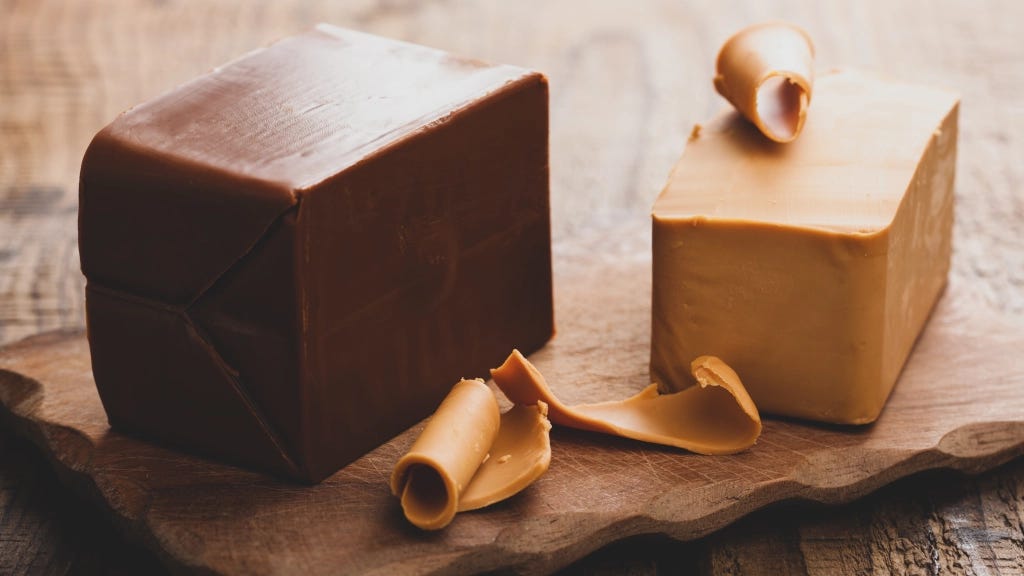
© A Nordic Fever
Anyway, off to do nurse duty. All three of my favourite blondes are laid up this week, on the injured list. Oakley has the beginnings of a hot spot behind his ear so he’s wearing the cone of shame, Bailey broke his nail and had to have it and the quick removed, so he’s wearing a cone of shame and Barb had a gum graft (no cone of shame). [Editor’s note: And he’s doing all this ministration while suffering from a paper cut that can almost be seen with the naked eye. Brave man, working through the pain.]
Until next time.